|
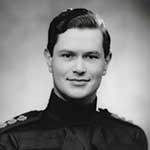
Major His Honour Jonathan van der Werff
Late Coldstream Guards
by his daughter Claudia van der Werff
|
Jonathan van der Werff who has died aged 90 had a varied and interesting career: 15 years a soldier, 17 years a barrister, 21 years a judge, and latterly an author.
He decided in his teens that he wanted to be a soldier. This feeling was underlined by his membership of a group of Harrow School Corps members who, amongst many from other schools, lined the route for King George VI’s funeral procession from Westminster Abbey to Paddington Station. That duty required the cadets to learn the recondite drills for reversing arms and resting on arms reversed. He greatly enjoyed what he saw that day and continued to like performing Public Duties for the whole of his service: innumerable Queen’s and Windsor Castle and Tower Guards and Bank Picquets and four Queen’s Birthday Parades. Whilst still at school he passed the Regular Commissions Board and the examination for entrance to Sandhurst.
After leaving Harrow he experienced a gap of a few months until he reported to the Guards Depot at Caterham in late November. He was living in London then and his mother persuaded him to get a job at Harrods, where he was assigned to the lampshade department as a packer/electrician. The former required packing sometimes very large lampshades, popular in those days with standard lamps, in brown paper and string (no sellotape then). His most vivid memory of his time there was the occasion when the Queen approached the display of lamps which were thought to make suitable Christmas presents while he was arranging them and fitting the plugs (in those days manufacturers did not fit plugs on their lamps). The Queen, who had been crowned only a few months earlier, was interested in a small bedside lamp and he was delighted to sell it to her (a Genie lamp, price two guineas). The Buyer, a formidable woman, saw what was going on and briskly elbowed him out of the way, but his sale had been completed. He imagined that the Queen bought the lamp as a Christmas present for somebody. Very very many years later he discovered that she had bought it for herself and that it was on her bedside table in her bedroom at Buckingham Palace. At Harrods he was paid £5 a week.
His Army life as a Coldstreamer began at Caterham in a Brigade Squad, where he was paid £1 a week, the routine was arduous but enjoyable and he made several friends who lasted his lifetime. At the Guards Training Battalion at Pirbright the recruits found their squad instructor to be less ferocious and more human. He liked his instructor so much that when he married 15 years later he asked his former instructor, by now the Sergeant Major of the Guards Depot, to form part of his Guard of Honour at the Guards’ Chapel. After 18 months at Sandhurst where he lived a strange quasi military existence he was commissioned and joined the 3rd Coldstream. Sandhurst in those days was not quite sure what it was training the cadets to be. A wit described the establishment as ‘a red-brick university where the OTC had got rather out of hand’. Jonathan enjoyed learning Spanish, economics and military history (Alexander the Great). He was Captain of Fencing. The one truly useful thing he learned, under the instruction of the legendary Academy Sergeant Major JC Lord, was how to drill, and to give words of command which would carry a real distance.
The 3rd Coldstream was then divided between Pirbright and the old original Chelsea Barracks, and public duties took up most of his time there. In 1956 the Battalion moved to Shorncliffe where they readied themselves for the invasion of Egypt following Nasser’s nationalisation of the Suez Canal. In the event the Battalion did not sail, though all their vehicles and equipment departed. When Operation Musketeer was concluded the equipment was returned, though all the really attractive items had been stolen. The losses were written off and nothing whatever was said about it. The next year the Battalion went to Germany and joined 4th Guards Brigade. For the first year Jonathan was the Intelligence Officer and spent much time in the frequent and sometimes enormous exercises in which BAOR were engaged. The following year he became the Mortar Officer, as he did the following year when the 3rd Battalion were disbanded and he went to join the 2nd Battalion in Kenya. In the summer of 1959, the 3rd Coldstream, now stationed at Wellington Barracks, bade its farewell to the Army. The Battalion marched from the Tower of London to Guildhall in the City to lay up its Colours while exercising its ancient right to march through the City with Colours flying, drums beating, bayonets fixed. Jonathan carried the Queen’s Colour and Willie Fox (later to be an actor called James Fox) carried the Regimental Colour. The Colours were later laid up in the Church of St Lawrence Jewry by Guildhall.
In Kenya, where the Mau Mau emergency was still officially in place, the 2nd Battalion had an interesting and enjoyable time because the contest was virtually over and all ranks enjoyed exploring the many fascinating scenes of the Kenyan country and the seaside of the Indian Ocean. Jonathan’s mortar platoon trained all over the place and saw every wild animal without ever entering a game reserve. In 1960 he returned to England to join the 1st Battalion, then at Lydd but later at Victoria Barracks, Windsor where he became the Adjutant, there and in British Guiana to which the Battalion went on a nine-month unaccompanied tour in 1962. This was another opportunity for all ranks to explore the country and to go on leave to Trinidad and other parts of the Caribbean. As an Old Harrovian Adjutant Jonathan was amused to find that all the majors in the Battalion were Old Etonians! Indeed, most of the junior Officers were also Etonians. The only other old Harrovian was the Signals Officer, Lieutenant Willie Rous (who was later the Colonel of the Regiment).
Towards the end of their time the local unions proclaimed a general strike and civil disobedience became the order of the day. The Battalion were reinforced by a Battalion of the Green Jackets and a Brigade HQ, but the behaviour of the local people was calmed by the demonstration in public in Georgetown of the way in which a well-trained platoon would deal with a riot. This was watched with interest by a large number of young men. In another town a budding riot was aborted by the brave action of a single Guardsman who arrested 15 young men using only his rifle and bayonet. (He was later awarded a BEM for gallantry). At the same time an Ensign, who had been knocked down by a cutlass wielding man who fortunately failed to injure him, later dealt with a further attack by four others who charged him from an alleyway waving their cutlasses. He twice called upon them to halt, but when they continued he fired one round at them which hit all four. Three were killed and one was wounded. Word of these incidents soon circulated throughout the Colony and misbehaviour ended.
Shortly after he returned to Windsor he finished his tour as Adjutant and went to the Ministry of Defence as a staff officer for two years in the Adjutant General’s Department, an experience which made him feel that regimental soldiering was what he liked best and a future in which he would spend much time on the staff was not really what he wanted in the long term. He returned to the 2nd Battalion at the new Chelsea Barracks as a company commander, where to his further amusement he found that all the majors were Old Harrovians! While enjoying public duties as he always did he began to think of his future and decided to go to the Bar. He passed most of the exams while still serving and ate his dinners in the Inner Temple. He retired at the end of 1968, by which time he had married his beloved Katie and was called to the Bar in 1969 having as he afterwards joked turned his bearskin into a wig in six months. In a kind valedictory letter, his Commanding Officer regretted the retirement of ‘the smartest officer I have known’.
He started as a barrister with a common law practice but soon settled down to life at the criminal bar. Fees in those days (as now) were minimal but as his practice progressed he was from time to time involved in the defence of many serious criminals, mostly bank robbers, in those days the cream of the criminal fraternity. When he was paid for this work he indulged himself with a visit to Hermes in Bond Street where he bought their silk scarves for Katie. By the time he left the bar and became a Crown Court Judge Katie had acquired a stack of the slim orange boxes containing the scarves, each of which was named after the appropriate criminal. During his time on the bench, he sat at all the central London crown courts including the Central Criminal Court (Old Bailey) and the Court of Appeal Criminal Division. He was the resident judge at Croydon Crown Court for 4 years trying many drug smuggling cases from Gatwick Airport and then the senior judge at the Inner London Crown Court for 13 years until he retired when he was 72. At Inner London he was permitted to try murders which he found fascinating. In retirement he remained in London. He had maintained a close contact with the Coldstream over the years partly because of his old friendships with Colonel Martin Maxse and Colonel Malcolm Havergal who commanded respectively the 1st and 2nd Battalions and later succeeded one another as Regimental Lieutenant Colonels. He was on the committee of the Nulli Secundus Club for 30 years (usual tour - three years) and was for 15 years the President of the London Branch of the Coldstream Association.
In 2014 his beloved Katie died after a long illness, thought at first to be Parkinsons but later accurately diagnosed as the rare Multiple Systems Atrophy from which she died. They had been happily married for 46 years and had two daughters.
Thereafter he lived a contented townie life reading voraciously, painting landscapes in oils, lunching and dining at his favourite clubs and restaurants, visiting theatres, indulging his lifelong passion for cinema and travelling in Europe and Africa.
For his fourth and final career he published two novels as James Ervine. The first, Morning of Eternity, a romance about the Captain of Queen’s Guard spotting a beautiful woman in the crowd outside Buckingham Palace. The second, The Picardy Conspiracy, a thriller about a young man at the Criminal Bar. It is hard to imagine where he found his inspiration!
He agreed with Solon’s dictum Call no man happy until he is dead, but until then he is only fortunate. Now that he is dead I know that he died a happy man. |
|